Halloween Sale: Free Express Shipping Until October 31, Plus 10% Off Everything Until December 31
Shop Now
Extra 10% Off Your First Order: Code WELCOME10
Create Account
Extra 5% Off Orders Over $3,000, Applied Automatically
Order by December 2 for Christmas Delivery (Express Shipping)
Lifetime Warranty on Manufacturing Defects | 15-Day Returns and Exchanges
Conditions apply
Gift-Ready Luxury Packaging | Free Shipping on All Orders!
Your welcome offer is ready. Apply it now and the saving shows at checkout.
WELCOME10 is applied. You save .
We could not apply the offer to this cart. If you think this is a mistake, please contact us.
We've sent you an email with a link to update your password.
Reset your password
We will send you an email to reset your password.
Radiant Cut Diamonds
What do you know about
diamonds
Explore the captivating world of diamonds. Learn about their origin, beauty, and the 4 Cs that define their quality. Welcome to the world of timeless elegance and enduring brilliance.
diamonds
Everything You Need to Know About Radiant Cut Diamonds
Quick Summary
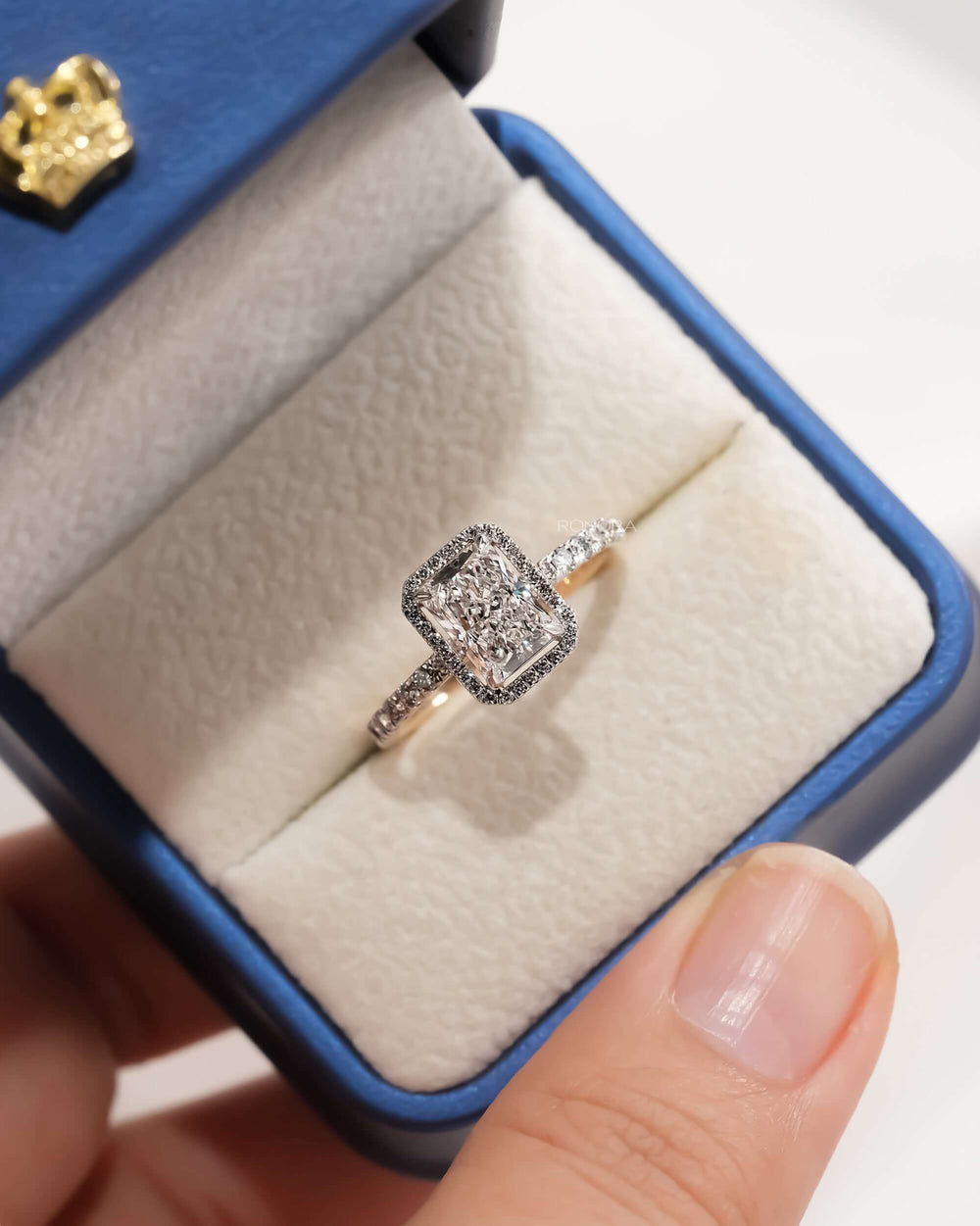
The radiant is the shape that refuses to choose. It takes the rectangular outline and cropped corners of an emerald cut, then fills them with brilliant faceting instead of steps. The result is the geometry of a step cut with the fire of a round. It is also one of the toughest shapes you can wear, because those cropped corners remove every fragile point. Hiding inclusions and warmth better than any step cut, it is the most forgiving of the angular shapes. Every Ronora radiant is Excellent cut, and our colourless radiants are D-E-F.
People usually arrive at the radiant from one of two directions. Either they love the clean rectangle of an emerald cut but miss the sparkle, or they love the fire of a round but want something less traditional. The radiant answers both.
It belongs firmly to the brilliant family of faceting styles, which the International Gem Society separates from step cuts. That is the whole trick of the shape: it looks like a step cut from across a room and behaves like a brilliant in your hand.
What Is a Radiant Cut Diamond?
A radiant is a rectangular or square stone with cropped corners and brilliant-style faceting, usually carrying around 70 facets. The extra facets compared with a round are what give it its particular crushed-ice sparkle: light breaks into many small pieces rather than a few large flashes.
The cropped corners matter more than they look. They remove the four weak points that make a princess vulnerable, which makes the radiant genuinely hard-wearing. There is nothing on the stone that can catch and chip.
Length-to-width ratio decides whether it reads as square or rectangular. Around 1.00 to 1.05 gives a square radiant. Around 1.30 to 1.50 gives the elongated version, which is the more popular of the two and flatters the finger the way an oval does.
A fancy green radiant in a bezel solitaire, the corners fully protected
A Short History of the Radiant Cut
The radiant is a modern invention with a clear author. It was created in 1977 by Henry Grossbard, a New York cutter who set out to solve a specific problem: rectangular diamonds looked beautiful but died in the middle, because step cutting simply does not return as much light as brilliant cutting.
His solution was to keep the emerald cut's outline and throw away its facet structure entirely, replacing it with a brilliant arrangement. It was the first cut to successfully combine the two, and everything in that family since, including the elongated cushion, owes something to it.
How to Buy a Radiant Cut Diamond
Decide square or elongated first
These are two quite different rings. A square radiant at a ratio near 1.00 sits compact and bold, closer in feel to a princess. An elongated radiant at 1.30 or above stretches along the finger and reads much closer to an oval.
Neither is better. But they photograph differently, they suit different hands, and they pair with different bands, so it is worth settling this before looking at anything else.
Radiants are not given an overall cut grade, so read the numbers. Depth between roughly 61% and 70% with a table around 61% to 69% gives the best light return. Too deep and the stone loses spread without gaining brilliance.
The other thing to know is that radiant faceting produces a crushed-ice look: many small sparkles rather than a few broad flashes. Some people love it; others prefer the larger, cleaner flashes of a round. It is a genuine preference, not a quality issue. Every Ronora radiant is Excellent cut.
This is where the radiant genuinely beats its relatives. All that brilliant faceting breaks light up fast enough to swallow small inclusions and mask slight warmth, which a step cut of the same outline could never do. If you want a rectangular diamond but do not want to pay step-cut prices for clarity, the radiant is the sensible answer.
It is also the reason radiants are so often used for fancy coloured diamonds: the faceting concentrates and intensifies colour rather than diluting it. Our fancy yellow and fancy green radiants exist for exactly that reason. Standard Ronora radiants remain D-E-F colourless.
A radiant carries more weight in its depth than an emerald cut of the same outline, so it spreads slightly less face-up for the same carat. An elongated radiant recovers most of that through its length, and on the hand the difference is small. Our diamond measurements guide shows the millimetre size at every carat weight, drawn at true scale.
It uses rough efficiently, which keeps the price per carat below a round. Because it hides inclusions and warmth so well, this is one of the few shapes where spending on carat weight rather than on the top of the clarity scale is genuinely defensible, though every Ronora stone stays within our ladder regardless.
See a radiant cut at actual size on your own ring size, or as a stud or pendant, with Find Me Diamond, our free diamond size visualizer.
1 carat radiant (6.2 x 4.8 mm) on a US size 6.5 finger. Covers about 28% of the finger's width. Illustration drawn to scale with Find Me Diamond.
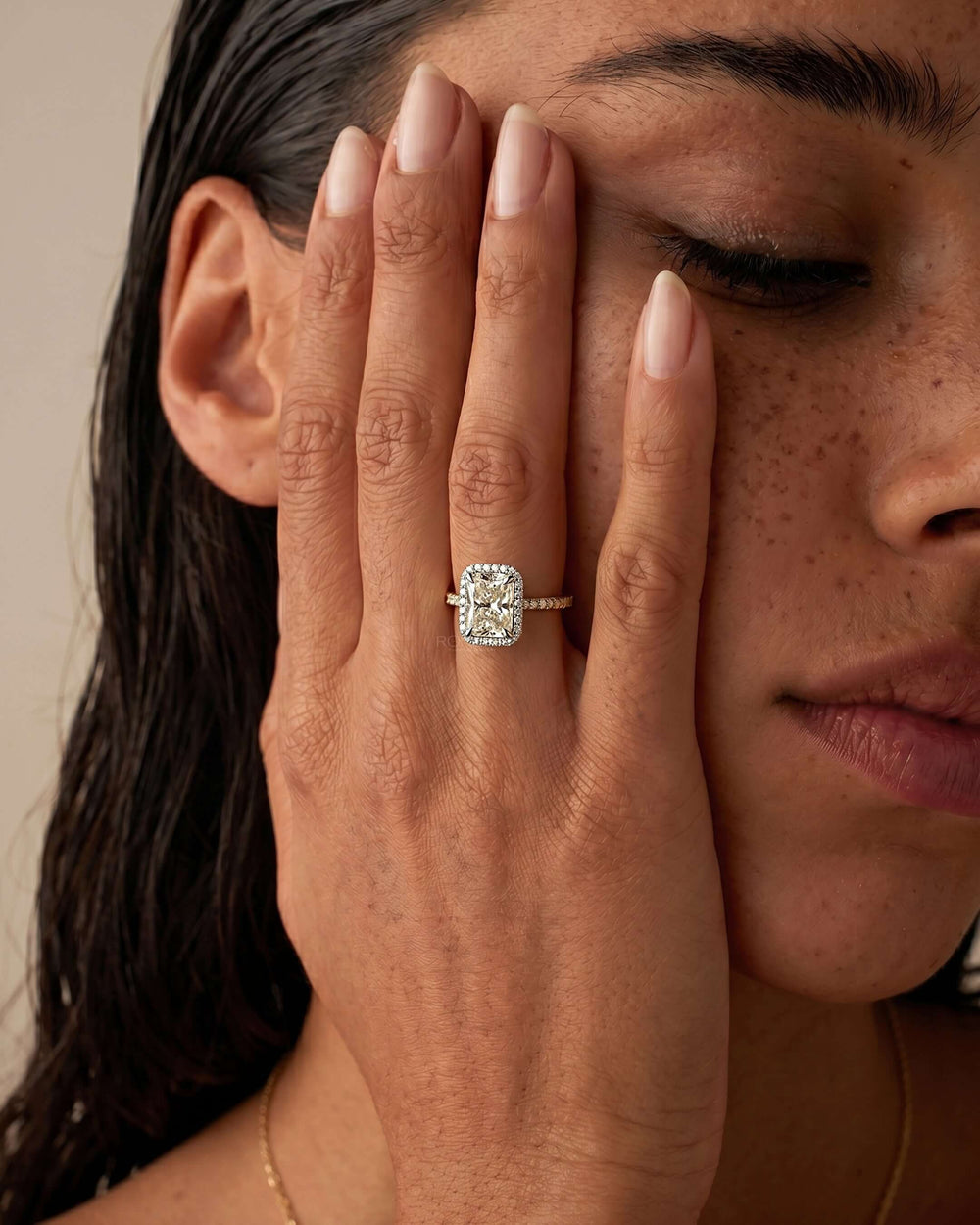
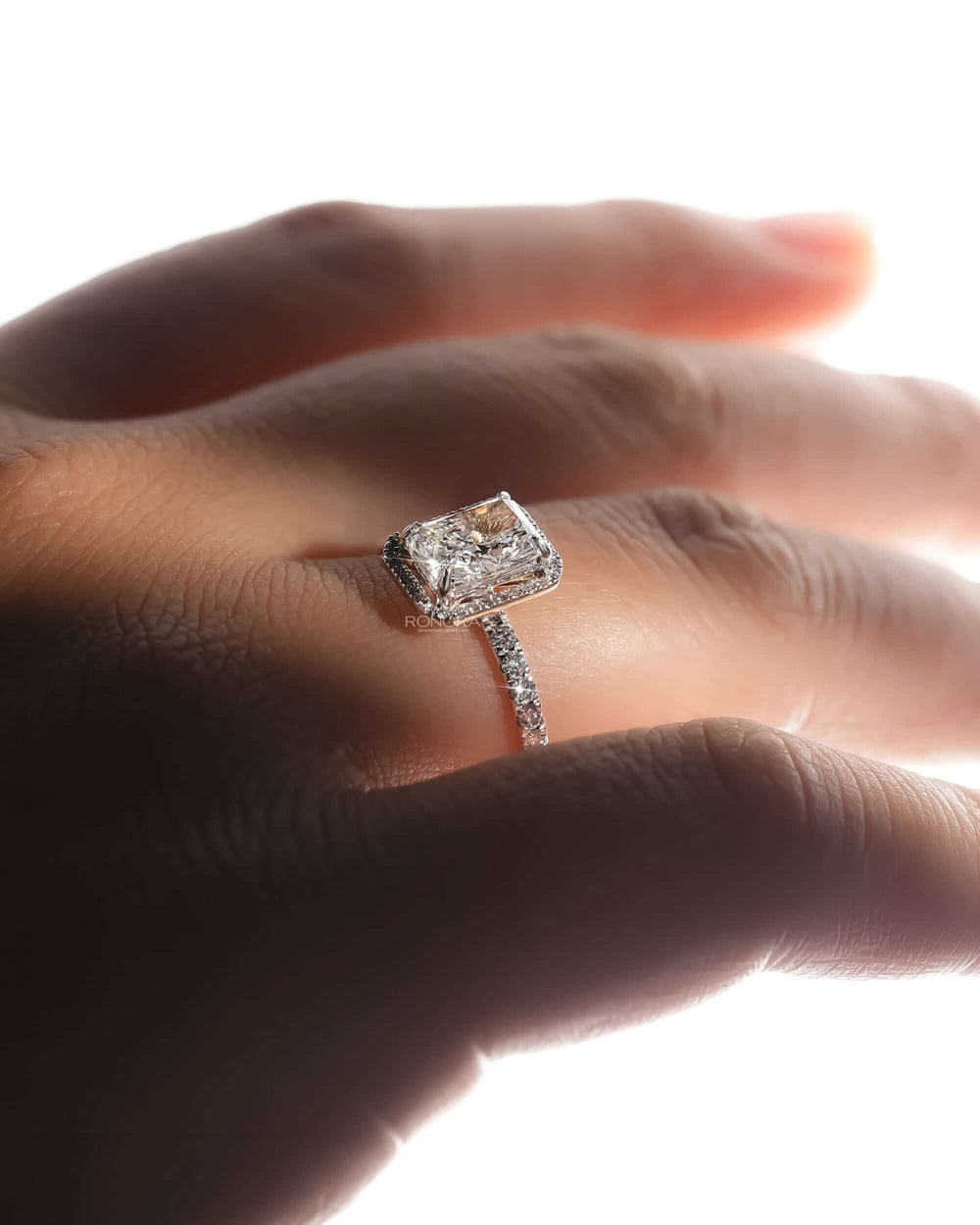
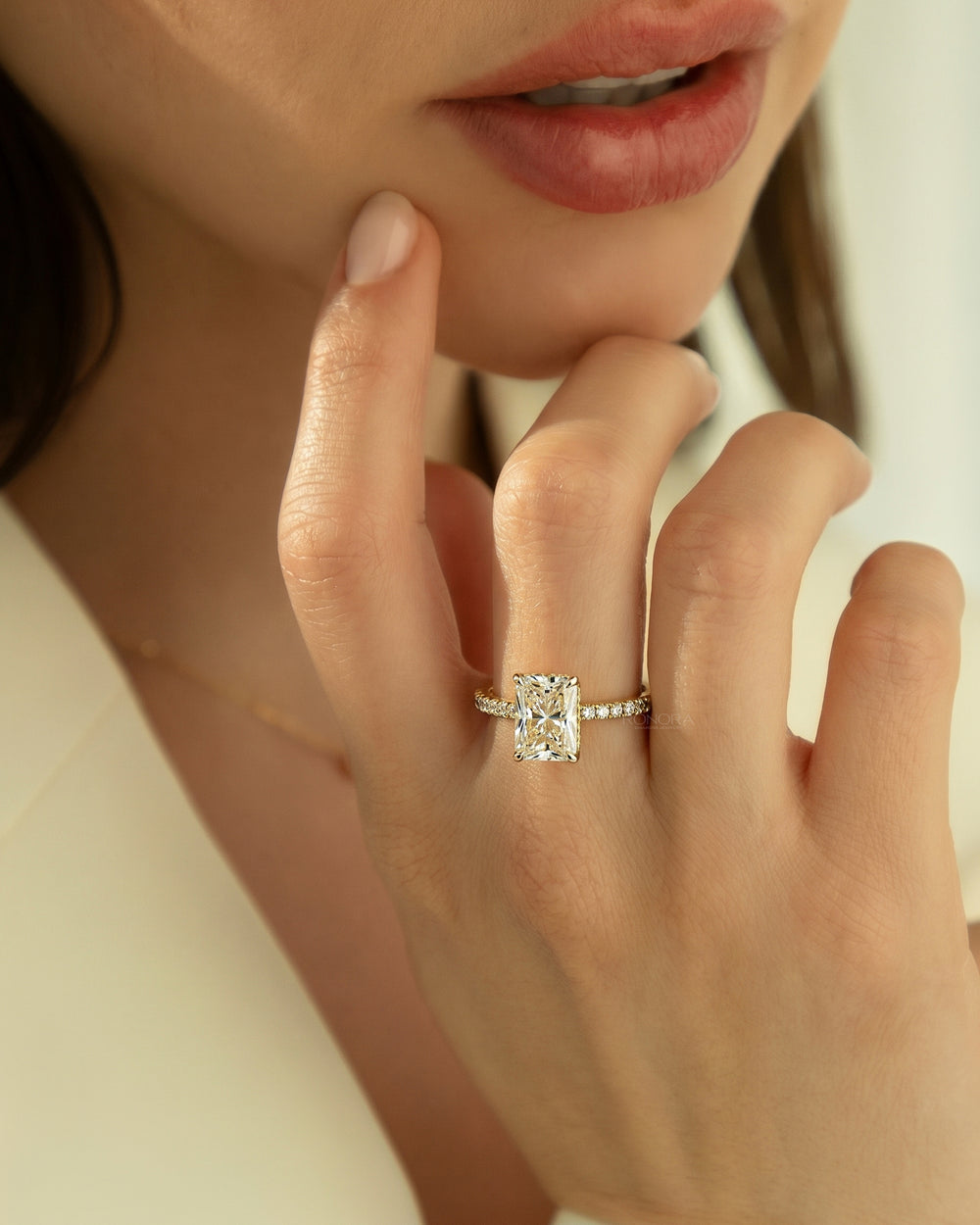
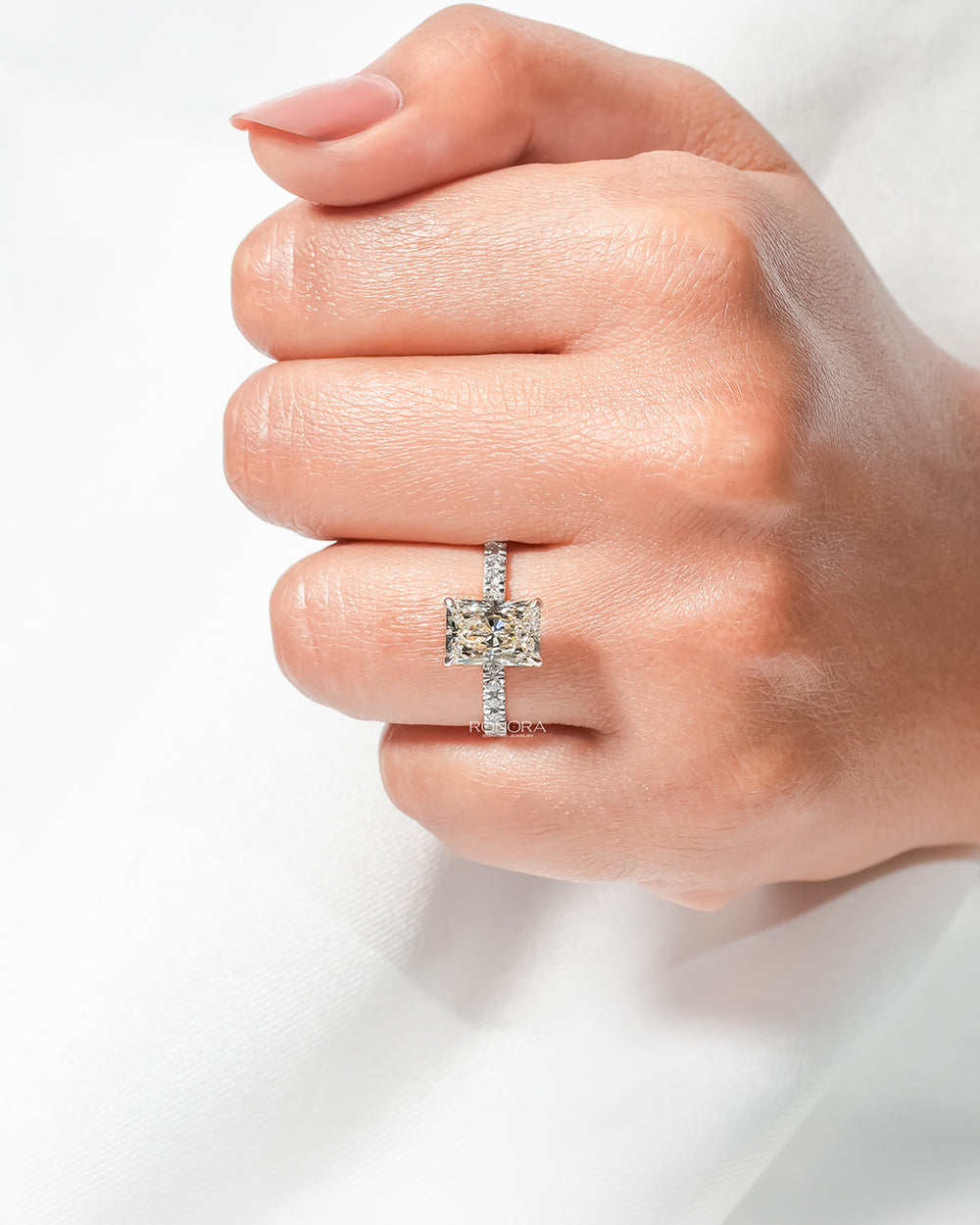
A radiant reads bold on the hand without any exposed corners
Best Settings for a Radiant Cut
With no fragile points, a radiant can be set almost any way you like. The decision is about what you want the shape to say.
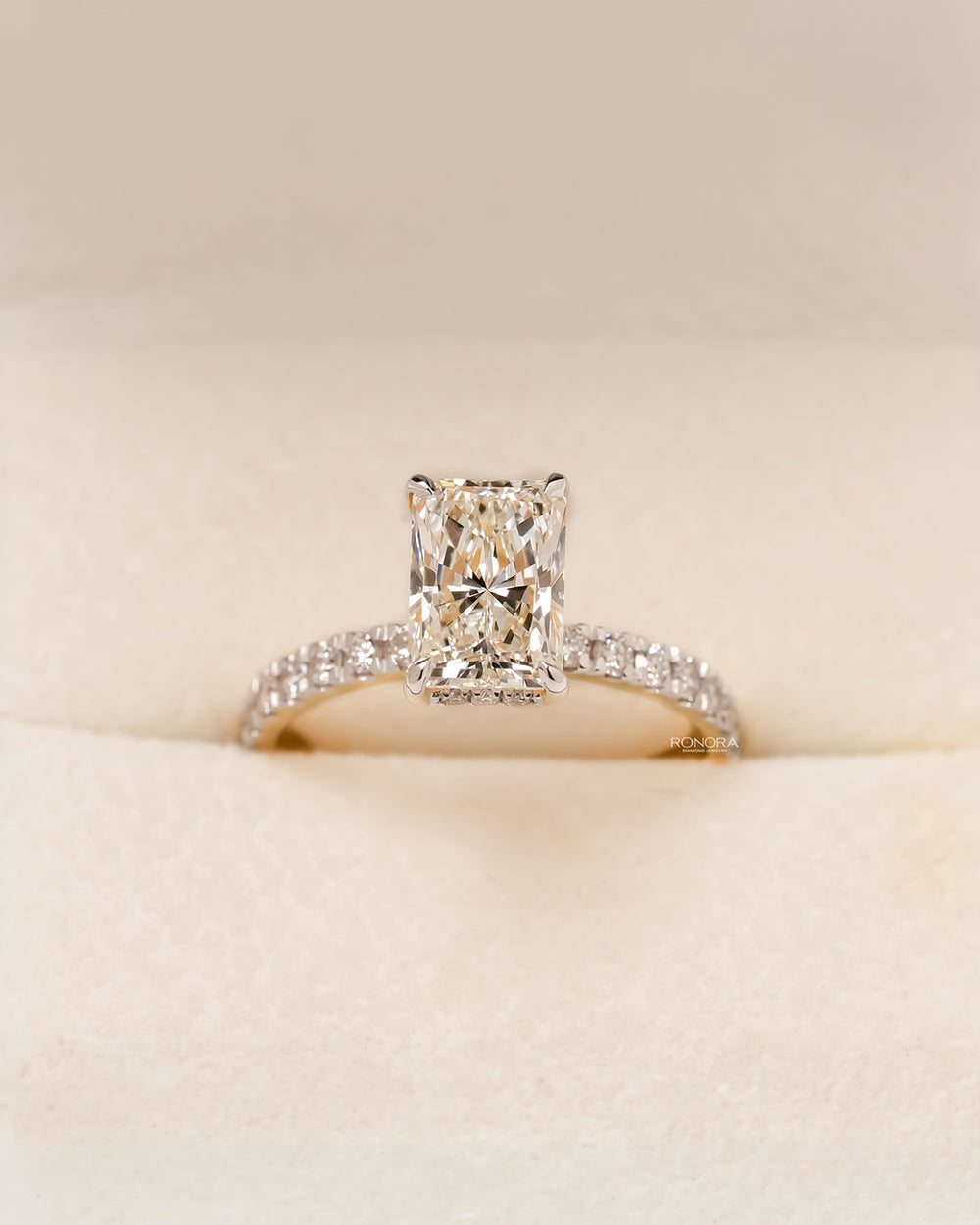
Four prong solitaire. Prongs on the cropped corners, nothing else. Shows the outline cleanly and lets the faceting do the work.
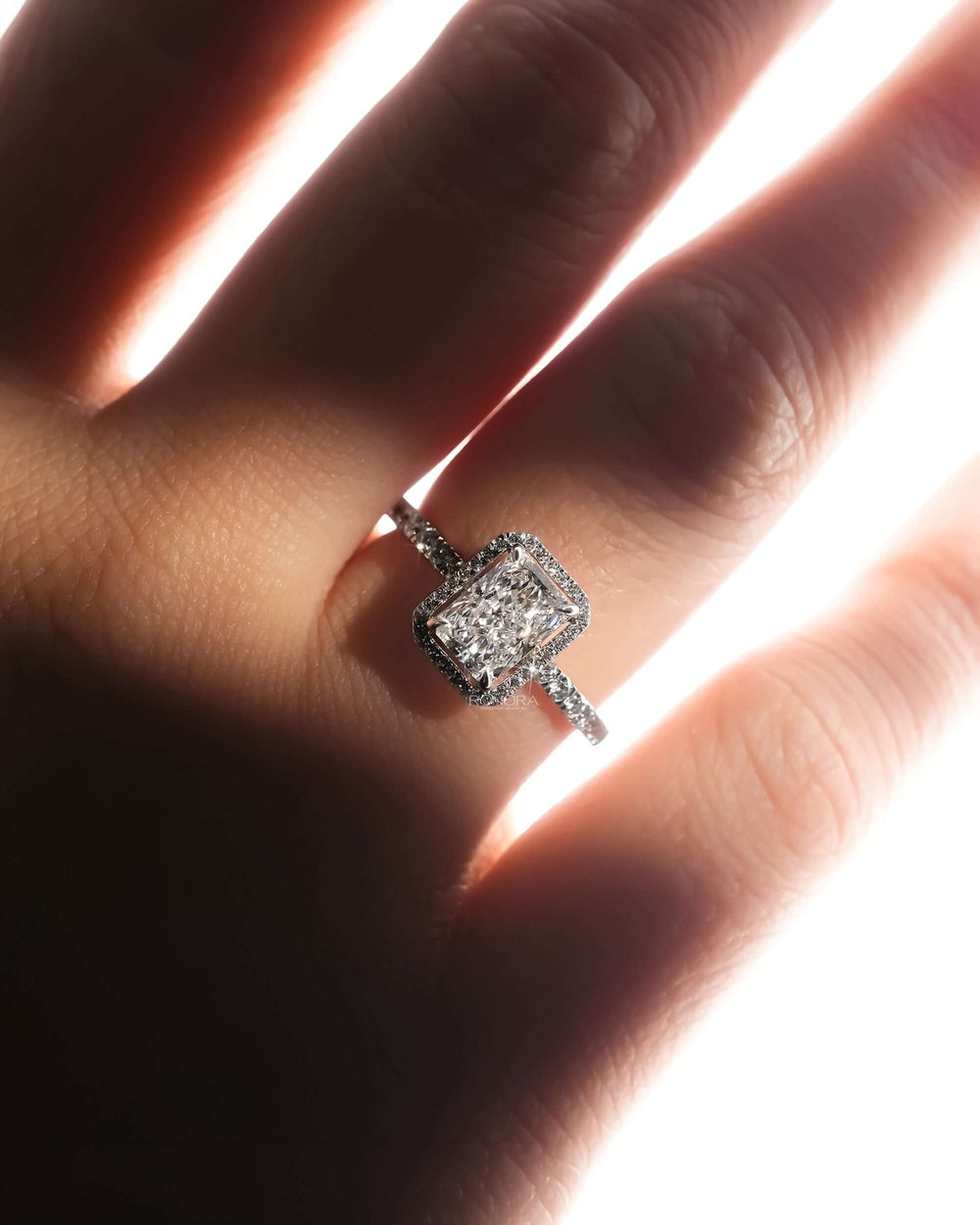
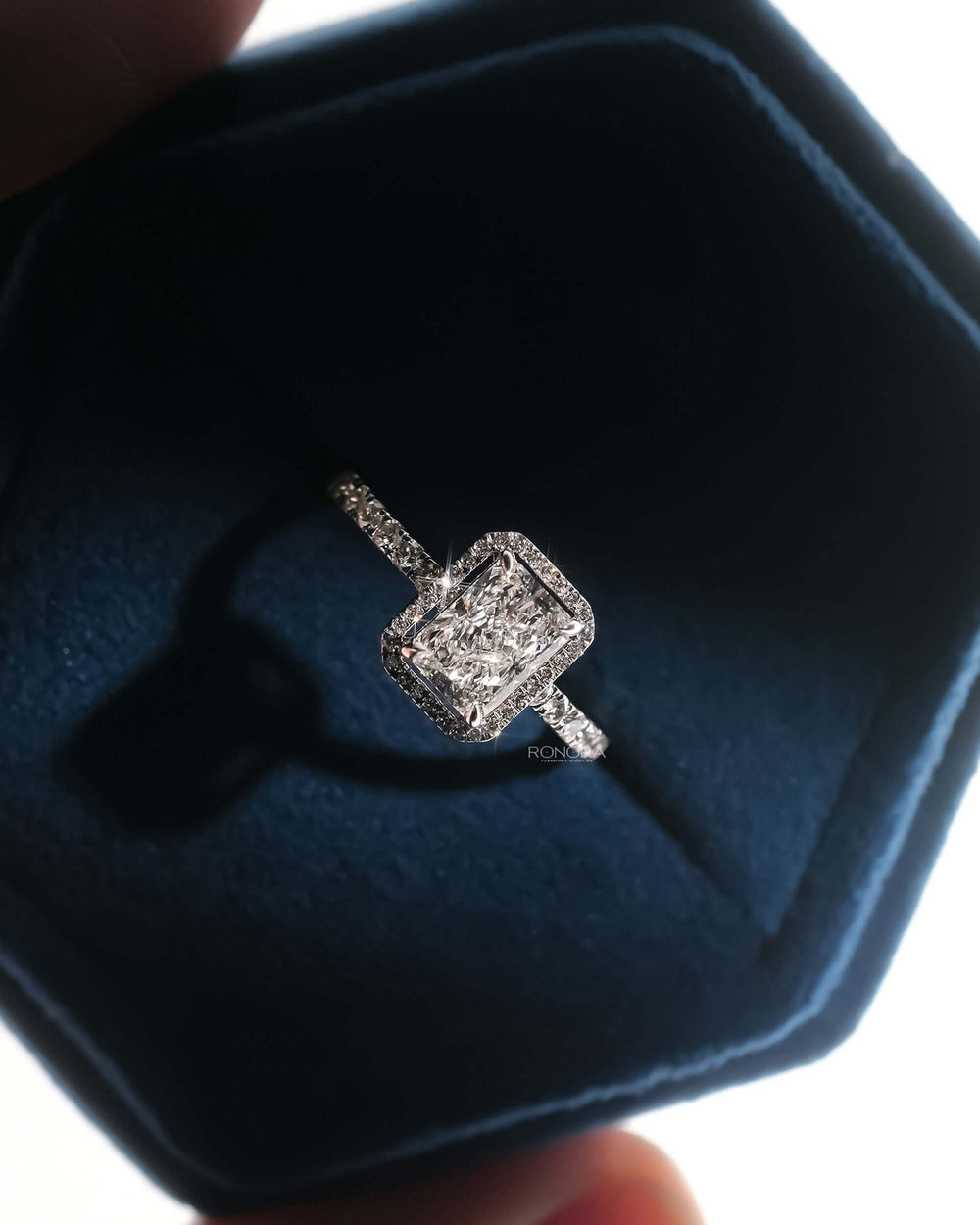
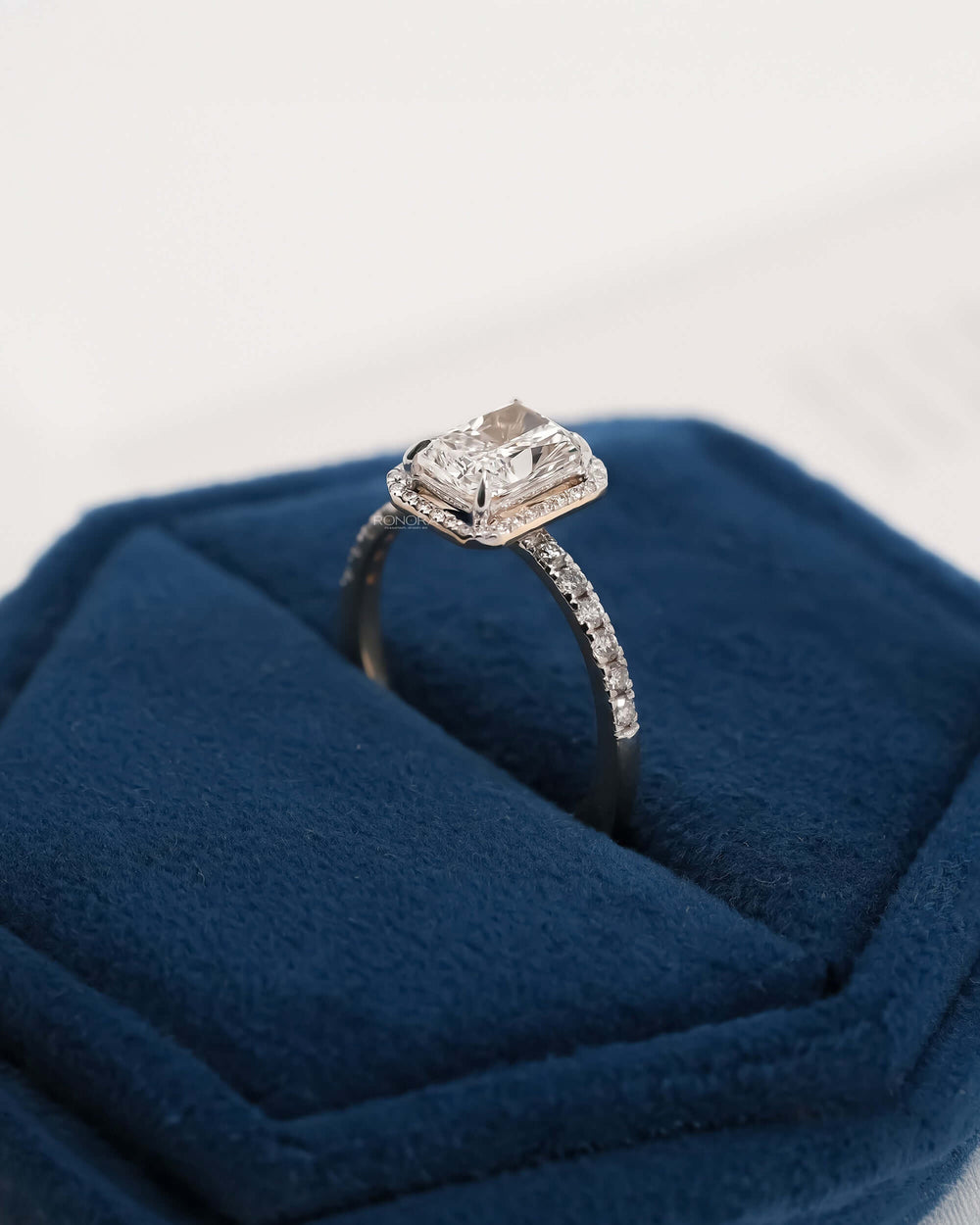
Halo. Very effective here. A frame of small rounds pushes an already generous outline larger and amplifies the crushed-ice sparkle.
Three stone with tapered baguettes. Straight side stones reinforce the rectangle and give a strong Art Deco line, particularly on an elongated radiant.
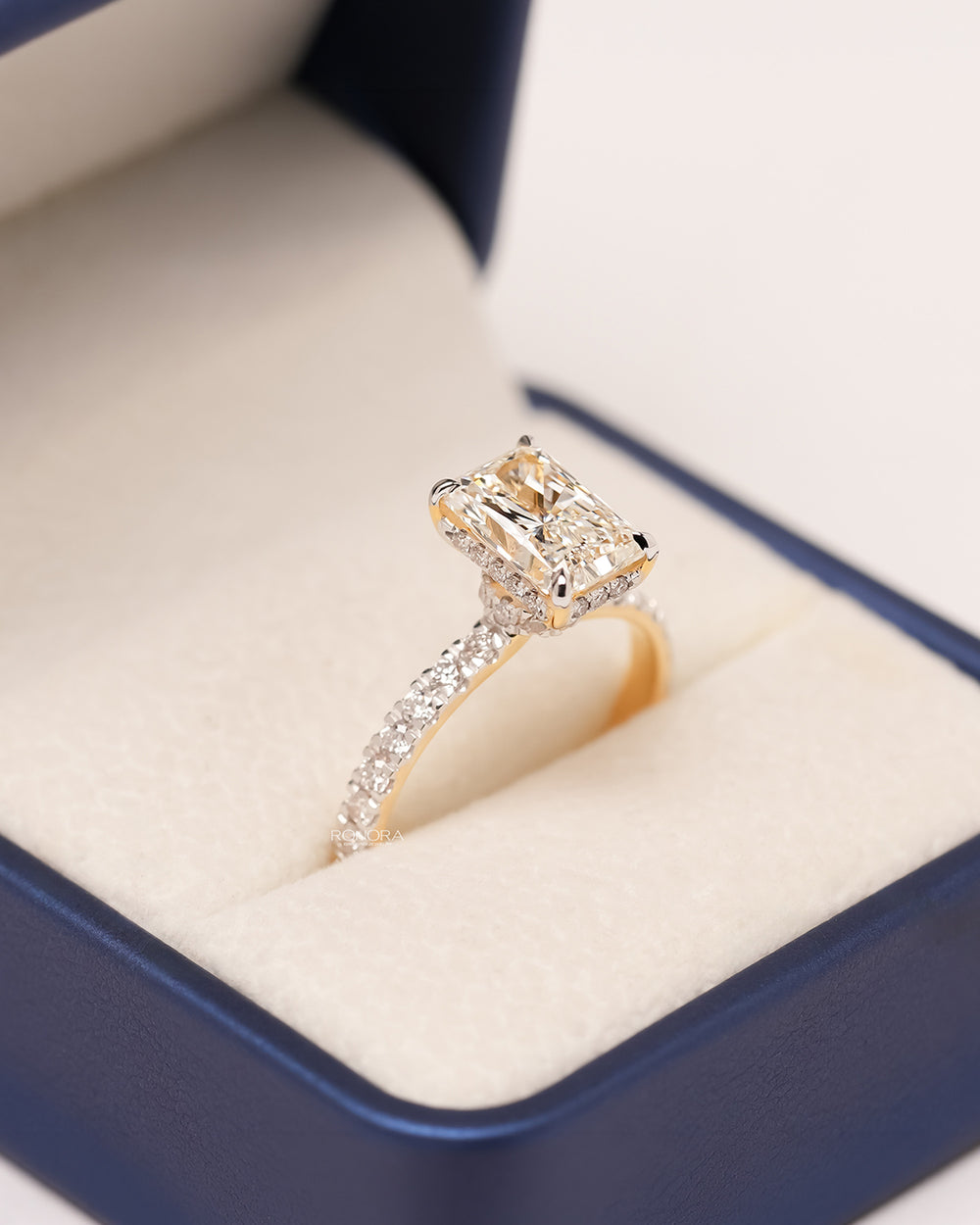
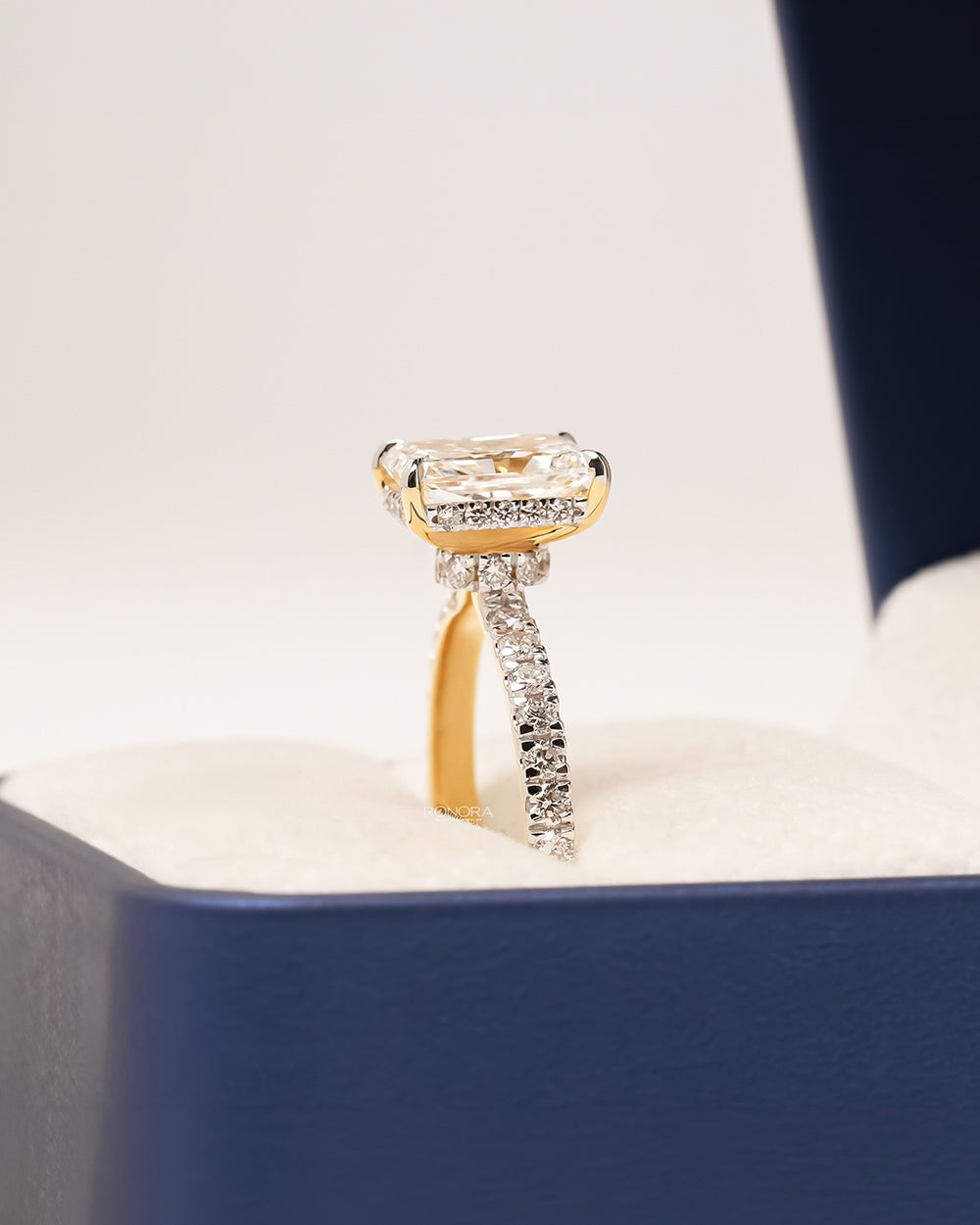
Pavé shank. Fine pavé along the band suits the radiant's busy sparkle better than it suits a step cut, where it would compete.
Bezel. A full rim traces the cropped corners neatly and gives the most secure, most minimal result.
Radiant faceting concentrates colour, which is why fancy colours suit it
Radiant Against the Other Shapes
The radiant sits between the emerald and the princess, and takes the best of both. Here is what it gives up and what it gains against each neighbour.
Radiant Against the Other Shapes
Compared with
What that shape does better
What the radiant does better
Choose the radiant if
Emerald
Long calm flashes, a true hall of mirrors
Rapid sparkle, and hides far more
You love the outline but not the restraint
Princess
A crisper, genuinely sharp square
Cropped corners, so nothing can chip
Durability matters as much as the shape
Cushion
Softer, warmer, more romantic
Sharper sparkle and a cleaner geometric edge
You want modern rather than antique
Round
Brighter, and the most classic outline
More spread per carat, at a lower price per carat
You want a rectangle that still sparkles
Oval
Smoother curves, and a softer silhouette
No bow-tie, and straight edges for baguette sides
You want length with angles rather than curves
One thing the table cannot show: radiant faceting concentrates fancy colour rather than diluting it, which is why so many yellow, pink and green diamonds are cut this way. See coloured diamond rings, or compare all twelve in diamond shapes.
Radiant Diamond Size Chart
Millimetre measurements for a well proportioned radiant at every carat weight we cut, with a round of the same weight in the last column so you can see the difference directly.
Radiant diamond sizes in millimetres by carat weight
Carat weight
Length × width
Approximate depth
A round of the same weight
0.50 ct
4.95 × 3.81 mm
2.67 mm
5.16 mm across
0.75 ct
5.67 × 4.36 mm
3.05 mm
5.91 mm across
1.00 ct
6.24 × 4.80 mm
3.36 mm
6.50 mm across
1.50 ct
7.14 × 5.49 mm
3.85 mm
7.44 mm across
2.00 ct
7.86 × 6.05 mm
4.23 mm
8.19 mm across
3.00 ct
9.00 × 6.92 mm
4.85 mm
9.37 mm across
These sizes assume the proportions we normally cut this shape to. The same weight drawn longer comes out narrower, and drawn rounder comes out wider. Set your own ratio and see the outline at true size on your screen with the diamond size calculator, or compare all twelve shapes side by side in the diamond measurements guide.
How a Radiant Diamond Looks on the Finger
The share of the finger's width a radiant cut diamond covers set north-south, with its length running along the finger, by carat weight and US ring size. It is the stone's width divided by the inside diameter of the ring, so the same diamond looks bigger on a smaller finger.
How a Radiant Diamond Looks on the Finger
Carat
Size (mm)
US size 5 (15.7 mm)
US size 6.5 (16.9 mm)
US size 8 (18.1 mm)
0.50 ct
5.0 × 3.8
24%
23%
21%
0.75 ct
5.7 × 4.4
28%
26%
24%
1.00 ct
6.2 × 4.8
31%
28%
27%
1.50 ct
7.1 × 5.5
35%
33%
30%
2.00 ct
7.9 × 6.0
39%
36%
33%
3.00 ct
9.0 × 6.9
44%
41%
38%
See a radiant cut on your own ring size, or as a stud or pendant, with Find Me Diamond, our free diamond size visualizer drawn at actual size.
Pros and Cons of the Radiant Cut
What it does well
Combines a rectangular outline with brilliant-cut fire, which no step cut can do.
Cropped corners make it one of the most durable shapes available.
Hides inclusions and warmth better than any angular alternative.
Available square or elongated, so it suits very different tastes.
Intensifies fancy colour, which is why coloured diamonds are so often cut this way.
What to watch
Crushed-ice sparkle is divisive. Some prefer the broader flashes of a round.
Carries weight in its depth, so it can spread less than an emerald of the same carat.
No official cut grade, so proportions must be read individually.
Square and elongated radiants are very different rings; decide which you mean.
Explore Ronora’s Radiant Cut Collection
Every Ronora radiant is a real lab grown diamond (CVD), Excellent cut (colourless stones are D-E-F), set by hand in Surat in solid 9K, 14K or 18K gold, platinum or 925 silver. We cut radiants in both square and elongated ratios, and it is the shape we reach for when a fancy colour needs to be at its most intense. Diamonds of one carat or more arrive with their own IGI certificate. Browse our lab grown diamond engagement rings, or compare the radiant against the other eleven shapes in our diamond shapes guide.
Join for new designs, ring guides and private offers.
Sign up in one step with Google or your email.
By signing up, you agree to receive Ronora Diamond marketing emails and accept our Privacy Policy. You can unsubscribe at any time. The 10% code works once, on your first order.