Halloween Sale: Free Express Shipping Until October 31, Plus 10% Off Everything Until December 31
Shop Now
Extra 10% Off Your First Order: Code WELCOME10
Create Account
Extra 5% Off Orders Over $3,000, Applied Automatically
Order by December 2 for Christmas Delivery (Express Shipping)
Lifetime Warranty on Manufacturing Defects | 15-Day Returns and Exchanges
Conditions apply
Gift-Ready Luxury Packaging | Free Shipping on All Orders!
Your welcome offer is ready. Apply it now and the saving shows at checkout.
WELCOME10 is applied. You save .
We could not apply the offer to this cart. If you think this is a mistake, please contact us.
We've sent you an email with a link to update your password.
Reset your password
We will send you an email to reset your password.
Dutch Marquise Diamonds
What do you know about
diamonds
Explore the captivating world of diamonds. Learn about their origin, beauty, and the 4 Cs that define their quality. Welcome to the world of timeless elegance and enduring brilliance.
diamonds
Everything You Need to Know About Dutch Marquise Diamonds
Quick Summary
A Dutch Marquise is an elongated hexagonal cut: six straight sides, two opposing points, and no curve anywhere in the outline. Despite the name it is not a marquise. A marquise is a navette, a pointed oval whose long wings bow outward. A Dutch Marquise takes that same long two-pointed silhouette and rebuilds it entirely out of straight lines, which is why it reads architectural rather than soft. It is one of the rarest shapes in the Ronora range. Every Ronora Dutch Marquise is Excellent cut in the D-E-F colourless range.
The name causes most of the confusion. People expect a marquise and find something else entirely: a long, flat-sided stone with sharp angled corners, closer in outline to an emerald cut than to the curved navette they were picturing. That surprise is the whole appeal.
Like the marquise it is faceted as a brilliant, one of the two broad faceting styles the International Gem Society separates from step cutting. So it sparkles in small bright flashes rather than in long mirrored planes, which is unusual for a shape carrying this much straight geometry.
What Is a Dutch Marquise?
A Dutch Marquise is a diamond cut to an elongated hexagonal outline. Trace the girdle and you count six straight edges: a point at the top, a point at the bottom, and two flat shoulders running between them down each side. There is no curve in the outline at any stage.
That is the one fact that separates it from the shape it is named after. A marquise is a navette, French for little boat, and its two long wings bow outward in a continuous curve. A Dutch Marquise keeps the length and the two points, then replaces every curve with a flat facet meeting its neighbour at a defined angle. Our marquise vs Dutch marquise comparison shows the two side by side at actual size.
The result sits between a marquise and a hexagon. It has the finger-lengthening proportions of the first and the deliberate geometry of the second. On a grading report the shape is described by its outline and faceting rather than by the trade name, so a certificate may print something closer to hexagonal modified brilliant than the words Dutch Marquise. Ask us for the exact wording on any stone before you order.
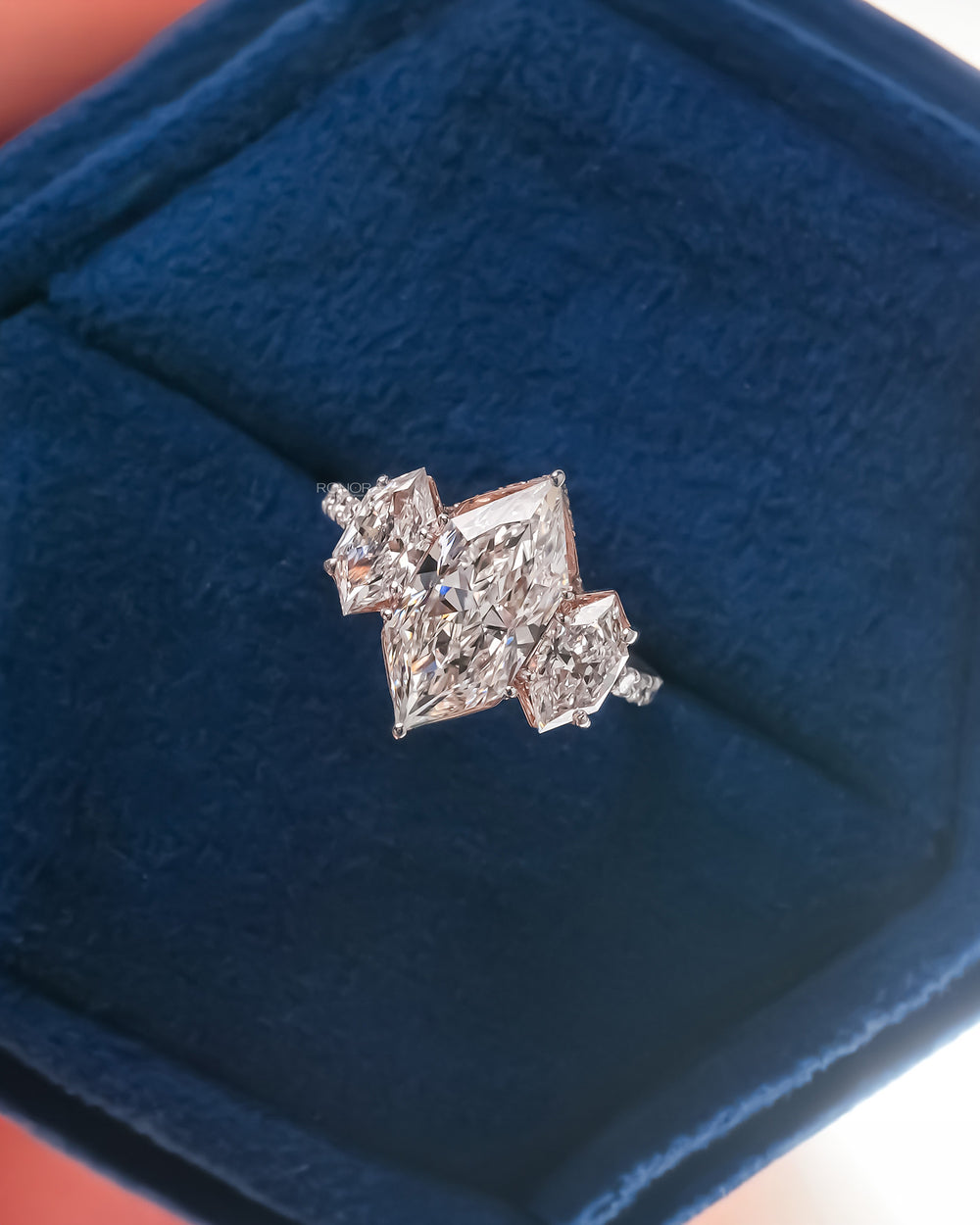
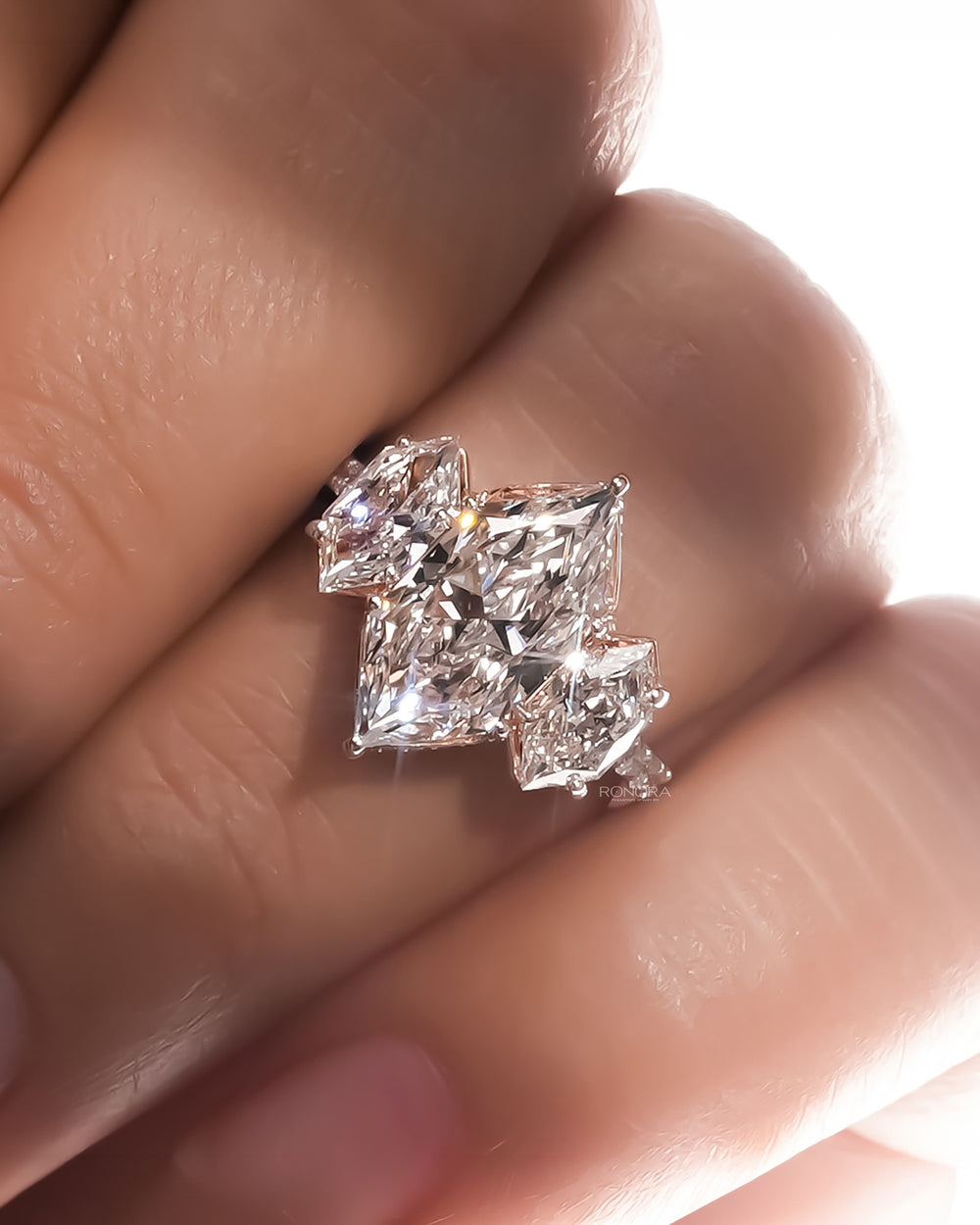
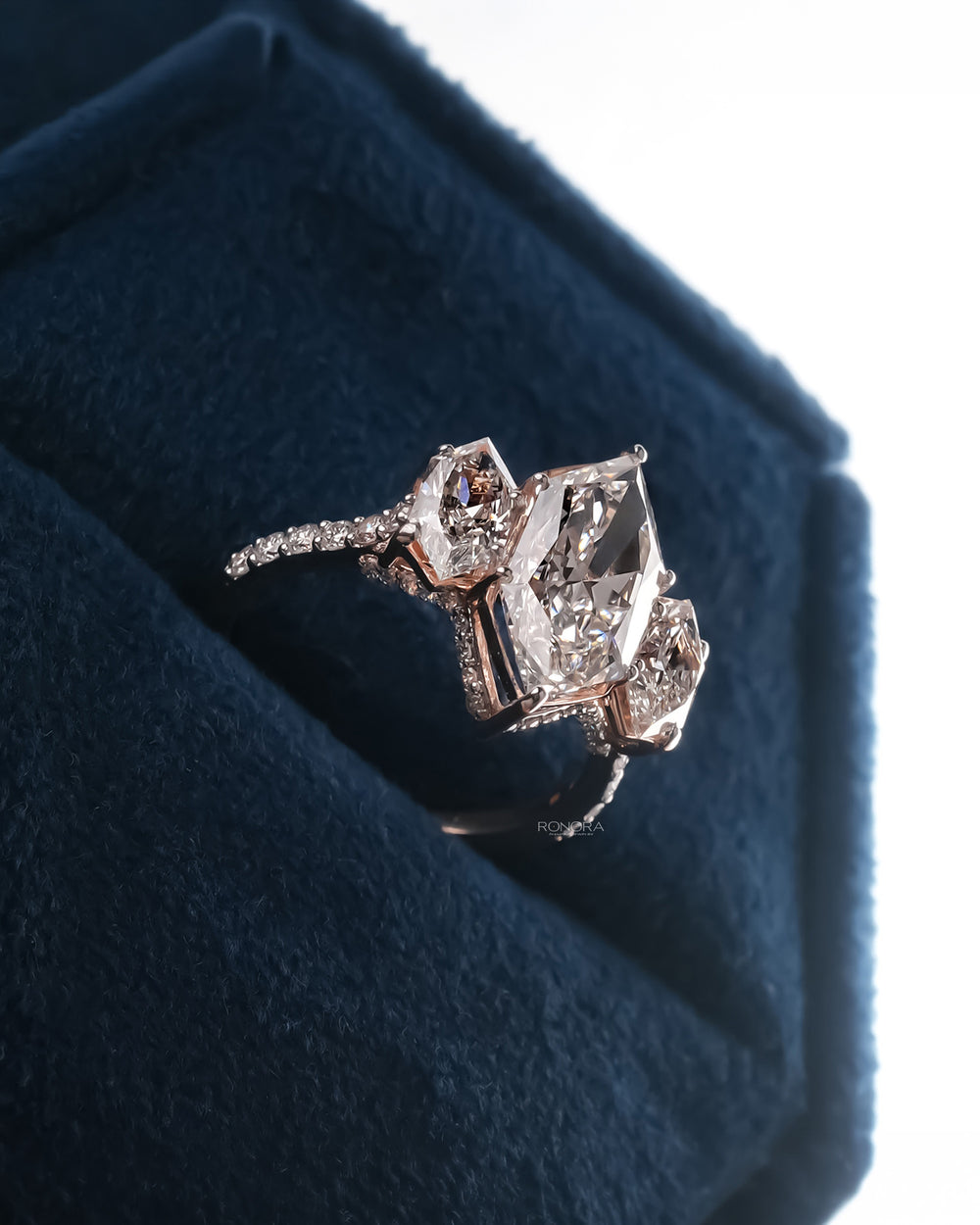
A three stone Dutch Marquise on a pavé band in rose gold
Where the Shape Comes From
The name points at the Low Countries, and it refers to a cutting tradition rather than to a dated invention. Antwerp and Amsterdam were the centre of European diamond cutting for centuries, and long, angular, flat-sided stones belonged to that vocabulary well before modern fancy shapes were standardised.
What survives today is a silhouette, not a fixed facet chart. A round brilliant has agreed proportions any cutter can follow. A Dutch Marquise does not. Each cutter decides how far to draw the length, how sharp to make the shoulders, and how much of the outline the two points take. That is why no two are quite alike, and why the shape has stayed rare.
A curve can absorb a small error. A straight edge cannot. On a Dutch Marquise each of the six sides is a visible reference line, so a shoulder sitting a fraction lower than the one opposite reads immediately as a lean rather than as a minor imperfection.
Check three things. Both points should sit on the same axis. The two shoulders on one side should mirror the two on the other. And the widest part of the stone should fall exactly halfway along its length. Our symmetry guide explains how this is graded.
Expect a bow-tie, and judge it
Every long brilliant shows a darker band across the centre, where the pavilion returns your own reflection instead of light. Narrow shapes show it most, and the Dutch Marquise is narrow.
This is the single biggest quality difference between one Dutch Marquise and another, and no certificate records it, because fancy shapes receive no overall cut grade. It has to be seen. Ask and we will describe the bow-tie on the exact stone honestly before you commit to anything.
Narrow tips concentrate warmth, and a Dutch Marquise has two of them. A stone that looks white across the body can still show a tint at both ends, and the flat shoulders leading into each point make that gradient easier to see rather than harder.
Ronora Dutch Marquise diamonds are D-E-F colourless only, which keeps the points as clean as the centre.
A Dutch Marquise spreads exceptionally well. Very little of its weight hides in the pavilion, so it covers far more finger than a round of the same carat weight. Our diamond measurements guide gives the millimetre size at every carat weight, so you can see the difference before you order.
The two points are the trade. They are the thinnest part of the stone and they need protection, so a V-prong or a bezel at each end is essential rather than advisable. Clarity is more forgiving, since brilliant faceting scatters light quickly enough to conceal small inclusions, though anything sitting near a point should be avoided on durability grounds alone.
See a Dutch marquise at actual size on your own ring size, or as a stud or pendant, with Find Me Diamond, our free diamond size visualizer.
1 carat Dutch marquise (9.0 x 4.8 mm) on a US size 6.5 finger. Covers about 29% of the finger's width. Illustration drawn to scale with Find Me Diamond.
Three elongated hexagons in a row, the setting style that suits this outline best
Best Settings for a Dutch Marquise
Two fine points to protect, and a flat-sided outline worth leaning into.
V-prong solitaire. The baseline. A V wraps each point completely instead of gripping it from one side. On a stone this narrow it is not optional.
Three stone with matching sides. The most sympathetic setting for this shape. Two smaller Dutch Marquise stones either side continue the straight-edged geometry instead of fighting it. Our side stone lab grown diamond rings include Dutch Marquise three stone designs.
East-west. Set across the finger rather than along it, the points tuck inside the band width and become far less exposed. It also shows the flat shoulders off, which are the most distinctive part of the outline.
Hexagonal halo. A halo that follows the six-sided outline instead of rounding it off keeps the geometry intact and makes the centre stone read noticeably larger.
Vintage detailing. Milgrain edges, filigree galleries and engraved shoulders all suit a shape this architectural.
Curved band. A long two-pointed stone rarely sits flush against a straight band, so a contoured wedding ring is usually the practical answer.
Worn along the finger, an elongated hexagon lengthens the hand
Dutch Marquise Against the Other Shapes
The first row is the comparison that actually matters, because the name sends almost everyone to the wrong shape first. The rest is context for how far this outline sits from the mainstream.
Dutch Marquise Against the Other Shapes
Compared with
What that shape does better
What the Dutch Marquise does better
Choose it if
Marquise
A curved navette outline, and far more stones to choose from
Six straight sides and a sharper, more architectural line
You want the length without the curves
Emerald
Calm step facets, a wider face and no bow-tie
Brilliant sparkle inside a straight-edged outline
You want geometry that still fires
Pear
One rounded end, so only one point to guard
Fully symmetrical, and far more unusual
Symmetry matters more than the teardrop
Oval
Nothing to chip, and an easier cut to judge
More finger coverage and a shape almost nobody has
Rarity matters more than easy wear
Round
Brightest, simplest, nothing to think about
Far more spread for the same carat weight
Presence on the finger matters most
This is a shape you choose deliberately. It asks for a V-prong at each tip, careful checking of symmetry and the bow-tie, and usually a curved band to sit beside it. In return you get an outline almost nobody else is wearing. Browse the Dutch Marquise collection, see how large it reads at every carat weight in our diamond measurements guide, or compare all twelve shapes in diamond shapes.
Dutch Marquise Diamond Size Chart
Millimetre measurements for a well proportioned dutch marquise at every carat weight we cut, with a round of the same weight in the last column so you can see the difference directly.
Dutch Marquise diamond sizes in millimetres by carat weight
Carat weight
Length × width
Approximate depth
A round of the same weight
0.50 ct
7.12 × 3.85 mm
2.62 mm
5.16 mm across
0.75 ct
8.15 × 4.41 mm
3.00 mm
5.91 mm across
1.00 ct
8.97 × 4.85 mm
3.30 mm
6.50 mm across
1.50 ct
10.27 × 5.55 mm
3.78 mm
7.44 mm across
2.00 ct
11.30 × 6.11 mm
4.16 mm
8.19 mm across
3.00 ct
12.94 × 6.99 mm
4.76 mm
9.37 mm across
The Dutch Marquise has no published trade size chart, because it is one of our own cuts rather than an industry standard. These are Ronora's working sizes at a 1.85 ratio, and a longer or shorter ratio at the same weight shifts both figures. Set your own ratio and see the outline at true size on your screen with the diamond size calculator, then ask us for the exact measurements on the stone you want.
How a Dutch Marquise Diamond Looks on the Finger
The share of the finger's width a Dutch marquise diamond covers set north-south, with its length running along the finger, by carat weight and US ring size. It is the stone's width divided by the inside diameter of the ring, so the same diamond looks bigger on a smaller finger.
How a Dutch Marquise Diamond Looks on the Finger
Carat
Size (mm)
US size 5 (15.7 mm)
US size 6.5 (16.9 mm)
US size 8 (18.1 mm)
0.50 ct
7.1 × 3.8
25%
23%
21%
0.75 ct
8.2 × 4.4
28%
26%
24%
1.00 ct
9.0 × 4.8
31%
29%
27%
1.50 ct
10.3 × 5.6
35%
33%
31%
2.00 ct
11.3 × 6.1
39%
36%
34%
3.00 ct
12.9 × 7.0
45%
41%
39%
See a Dutch marquise on your own ring size, or as a stud or pendant, with Find Me Diamond, our free diamond size visualizer drawn at actual size.
Pros and Cons of the Dutch Marquise
What it does well
Genuinely rare. Very few jewellers cut this outline at all.
Six straight sides give it a look no curved shape can copy.
Spreads exceptionally well, so it looks large for its carat weight.
Strongly finger-lengthening, especially set north-south.
Brilliant faceting, so it sparkles rather than flashing in long planes.
Suits hexagonal halos, matching side stones and vintage detailing.
What to watch
Two fine points that must be protected. A V-prong or bezel is essential.
Straight edges make any symmetry error immediately visible.
Expect a bow-tie, and judge how strong it is before buying.
Colour gathers at both tips.
Usually needs a curved or contoured wedding band to sit flush.
The name misleads. Confirm you are buying a hexagonal outline and not a navette.
Explore Ronora’s Dutch Marquise
The Dutch Marquise is one of the rarest shapes we cut and one of the hardest to find anywhere. Ronora currently offers five: a halo, a three stone, an east-west solitaire, a three stone with a hidden halo and an east-west bypass. Every stone is a real lab grown diamond, Excellent cut, in the D-E-F colourless range, set by hand in Surat in solid 9K, 14K or 18K gold, platinum or 925 silver, with both points properly protected. If you have a particular length-to-width ratio or setting in mind, ask and we will cut to it. Browse the Dutch Marquise collection, check the size first in our diamond measurements guide, or compare it against the other eleven shapes in our diamond shapes guide.
Join for new designs, ring guides and private offers.
Sign up in one step with Google or your email.
By signing up, you agree to receive Ronora Diamond marketing emails and accept our Privacy Policy. You can unsubscribe at any time. The 10% code works once, on your first order.