Halloween Sale: Free Express Shipping Until October 31, Plus 10% Off Everything Until December 31
Shop Now
Extra 10% Off Your First Order: Code WELCOME10
Create Account
Extra 5% Off Orders Over $3,000, Applied Automatically
Order by December 2 for Christmas Delivery (Express Shipping)
Lifetime Warranty on Manufacturing Defects | 15-Day Returns and Exchanges
Conditions apply
Gift-Ready Luxury Packaging | Free Shipping on All Orders!
Your welcome offer is ready. Apply it now and the saving shows at checkout.
WELCOME10 is applied. You save .
We could not apply the offer to this cart. If you think this is a mistake, please contact us.
We've sent you an email with a link to update your password.
Reset your password
We will send you an email to reset your password.
Cushion Cut Diamonds
What do you know about
diamonds
Explore the captivating world of diamonds. Learn about their origin, beauty, and the 4 Cs that define their quality. Welcome to the world of timeless elegance and enduring brilliance.
diamonds
Everything You Need to Know About Cushion Cut Diamonds
Quick Summary
A square cushion cut diamond measures about 5.5 × 5.5 mm at 1 carat. At 0.5 carat it is about 4.4 × 4.4 mm, at 1.5 carats 6.3 × 6.3 mm, at 2 carats 6.9 × 6.9 mm and at 3 carats 7.9 × 7.9 mm. The cushion diamond size chart further down the page also gives the depth and the size of a round of the same weight, and the longer shape has its own elongated cushion size chart.
The cushion is a square or rectangular stone with rounded corners and gently curved sides, shaped like a pillow. It is the direct descendant of the old mine cut, which was the standard for well over a century before the round brilliant arrived, and it carries that history in its softer, warmer glow. Cushions come in two quite different personalities, chunky and crushed ice, and knowing which you want matters more than any other decision on this shape. Every Ronora cushion is Excellent cut in the D-E-F colourless range.
If the round brilliant is precision and the emerald is architecture, the cushion is romance. Its rounded corners and curved sides give it a softness that no angular shape can manage, and it glows rather than flashes. People who describe wanting something antique, warm or candlelit are usually describing a cushion.
It is a brilliant cut, one of the styles the International Gem Society distinguishes from step cutting, so it sparkles freely and forgives small inclusions well.
What Is a Cushion Cut Diamond?
A cushion cut is a brilliant with a square or slightly rectangular outline, rounded corners and softly bowed sides. Facet counts vary widely, typically from 58 upward, and that variation is exactly why two cushions can look so unlike each other.
Chunky cushions use fewer, larger facets. They produce broad, slow flashes of light and dark, closer to the antique stones the shape descends from. Crushed ice cushions use many small facets, producing a glittering, granular sparkle that scatters rather than flashes.
Neither is better cut than the other; they are different designs. But they photograph differently and they wear differently, so it is worth deciding which one you actually want before comparing stones.
Length-to-width ratio between 1.00 and 1.09 reads as square. Above about 1.15 you are into elongated cushion territory, which is a distinctly different look.
Cushion and pear cut stones side by side
A Short History of the Cushion Cut
The cushion is the oldest shape still in mainstream use. Its ancestor is the old mine cut, developed in the eighteenth century and dominant until the early twentieth. Those stones were cut by candlelight, for candlelight, with small tables and deep pavilions that produced a warm, soft flicker rather than bright sparkle.
When the modern round brilliant arrived in 1919 it made the old mine cut technically obsolete overnight. But the look never lost its admirers, and the modern cushion is essentially that antique silhouette re-cut with contemporary precision. Read more about its direct ancestor at the International Gem Society.
Chunky or Crushed Ice
Both are sold simply as cushion cuts, and they are the two most different stones you can buy under one name. This is the decision that defines the ring.
Chunky or Crushed Ice
Chunky cushion
Crushed ice cushion
Facets
Fewer and larger
Many and small
What you see
Broad slow flashes of light and dark
Fine granular glitter across the whole stone
Character
Unmistakably antique
Modern and lively
Hides inclusions
Less well. Larger facets show more
Extremely well. Almost nothing shows
Shows colour
Sooner, so keep the grade high
Later, the scatter disguises warmth
In photographs
Can read dark
Can read busy or hazy
Best setting
Vintage, milgrain, plain solitaire
Halo and modern settings
Closest relative
The antique old mine cut
A crushed ice radiant
Photographs make this genuinely hard to judge, because crushed ice photographs as busy and chunky photographs as dark. Tell us which effect you want and we will match the stone to it rather than sending whatever is nearest in carat weight.
Cushions receive no overall cut grade, so read the numbers. Depth between roughly 61% and 68% with a table around 61% to 67% gives the best balance. Cushions historically run deep, which is why an older-style stone can look smaller than its carat weight suggests.
Check the corners too. They should all be rounded to the same degree; uneven corners make the pillow look lopsided. Every Ronora cushion is Excellent cut.
Cushions hold colour slightly more than a round brilliant. The deeper pavilion and larger facets give warmth more room to show, and on a chunky cushion in particular a faint tint becomes visible sooner than it would elsewhere.
Some people actively want that, setting a slightly warm cushion in yellow or rose gold for a deliberately antique effect. Ronora takes the other route: every cushion sits in the D-E-F colourless range, so the softness comes from the cut rather than from the colour.
A one carat cushion measures roughly 5.5mm by 5.5mm against about 6.5mm across for a one carat round. Cushions carry weight in their depth, so they spread a little less face-up. An elongated cushion recovers some of that through length, and our diamond measurements guide draws both at true size so you can compare them properly.
On durability the cushion is excellent. Rounded corners mean there is nothing to chip, which makes it one of the safest shapes for someone who works with their hands. Clarity is forgiving too, particularly on crushed ice stones where the granular sparkle hides almost everything.
See a cushion cut at actual size on your own ring size, or as a stud or pendant, with Find Me Diamond, our free diamond size visualizer.
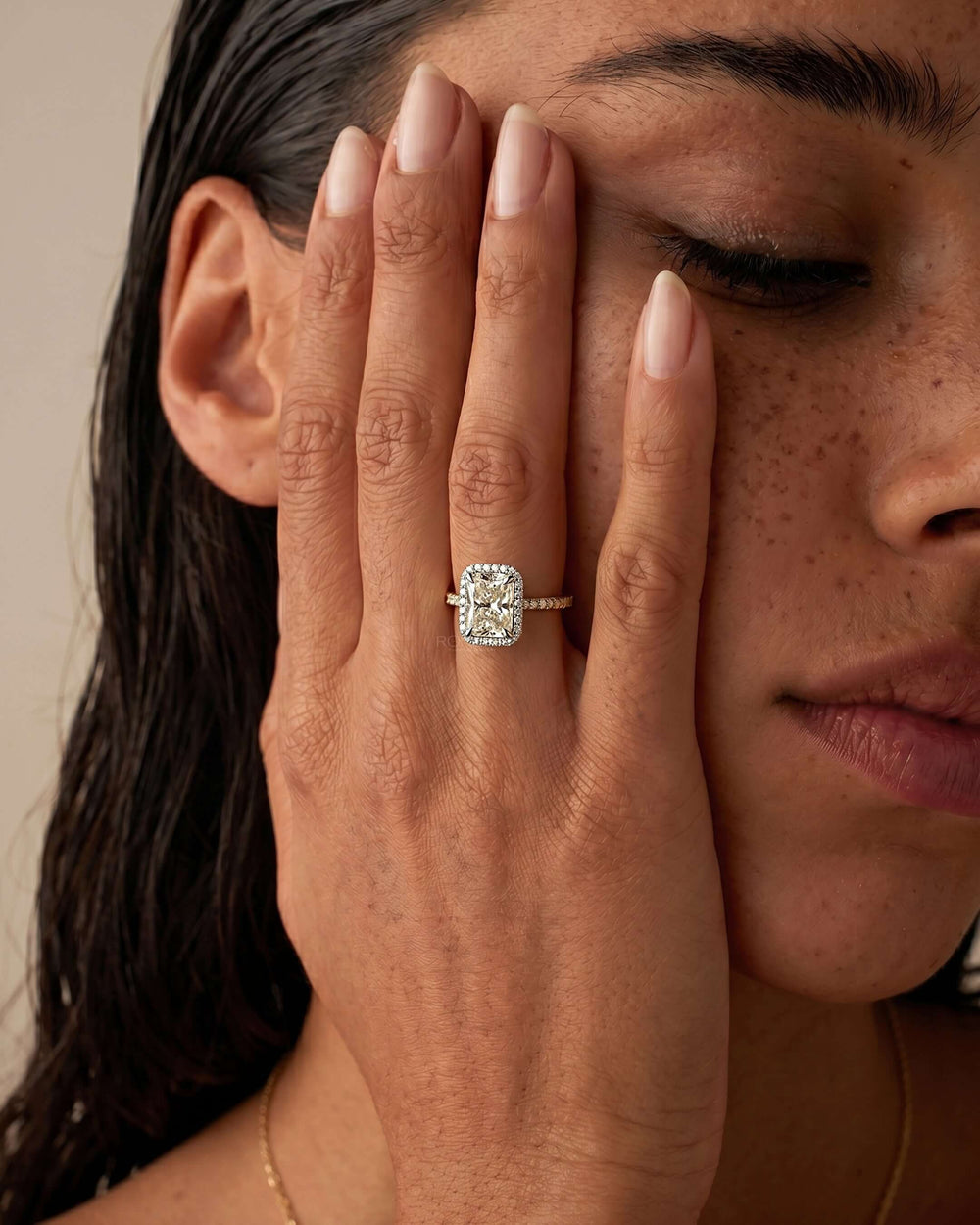
1 carat cushion (5.5 x 5.5 mm) on a US size 6.5 finger. Covers about 33% of the finger's width. Illustration drawn to scale with Find Me Diamond.
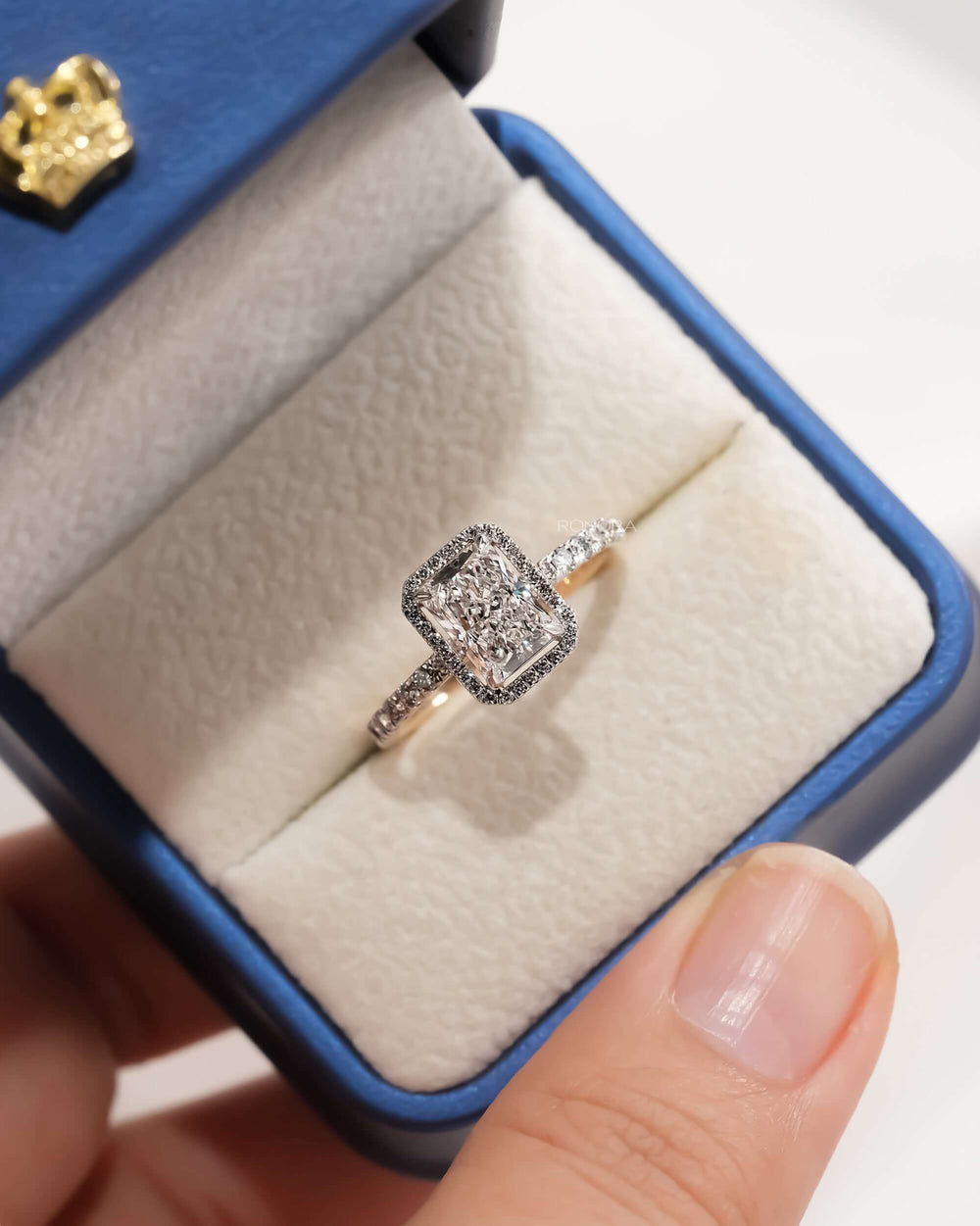
Softened square and rounded shapes set with pavé
Cushion Diamond Size Chart
Millimetre measurements for a well proportioned cushion at every carat weight we cut, with a round of the same weight in the last column so you can see the difference directly.
Cushion diamond sizes in millimetres by carat weight
Carat weight
Length × width
Approximate depth
A round of the same weight
0.50 ct
4.37 × 4.37 mm
2.97 mm
5.16 mm across
0.75 ct
5.00 × 5.00 mm
3.40 mm
5.91 mm across
1.00 ct
5.50 × 5.50 mm
3.74 mm
6.50 mm across
1.50 ct
6.30 × 6.30 mm
4.28 mm
7.44 mm across
2.00 ct
6.93 × 6.93 mm
4.71 mm
8.19 mm across
3.00 ct
7.93 × 7.93 mm
5.39 mm
9.37 mm across
These sizes assume the proportions we normally cut this shape to. The same weight drawn longer comes out narrower, and drawn rounder comes out wider. Set your own ratio and see the outline at true size on your screen with the diamond size calculator, or compare all twelve shapes side by side in the diamond measurements guide.
How a Cushion Diamond Looks on the Finger
The share of the finger's width a cushion cut diamond covers, by carat weight and US ring size. It is the stone's width divided by the inside diameter of the ring, so the same diamond looks bigger on a smaller finger.
How a Cushion Diamond Looks on the Finger
Carat
Size (mm)
US size 5 (15.7 mm)
US size 6.5 (16.9 mm)
US size 8 (18.1 mm)
0.50 ct
4.4 × 4.4
28%
26%
24%
0.75 ct
5.0 × 5.0
32%
30%
28%
1.00 ct
5.5 × 5.5
35%
33%
30%
1.50 ct
6.3 × 6.3
40%
37%
35%
2.00 ct
6.9 × 6.9
44%
41%
38%
3.00 ct
7.9 × 7.9
51%
47%
44%
See a cushion cut on your own ring size, or as a stud or pendant, with Find Me Diamond, our free diamond size visualizer drawn at actual size.
Best Settings for a Cushion Cut
Rounded corners mean nothing needs protecting, so a cushion can go into almost any setting. The question is whether you lean into its antique character or push against it.
Halo. The natural partner. A frame of small rounds echoes the curved outline and makes a cushion read considerably larger, since cushions spread less than other shapes.
Vintage and milgrain. Fine beaded edges, filigree and detailed galleries suit the cushion's history better than any other shape.
Four or six prong solitaire. Clean and simple, letting the pillow outline speak. Works best on a chunky cushion where the facets carry the interest.
Three stone. Rounds or half-moons either side complement the curves without fighting them.
Bezel. A rim follows the soft outline beautifully and gives a modern reading of an old shape.
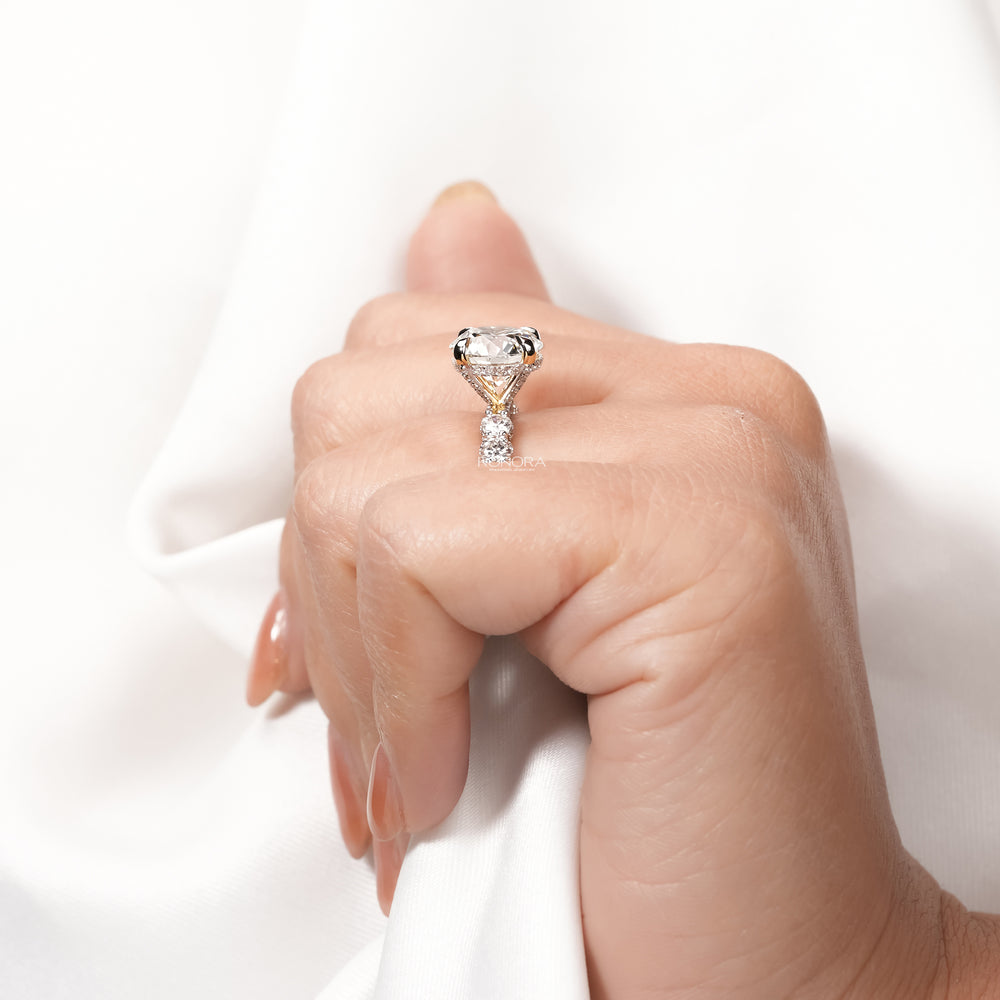
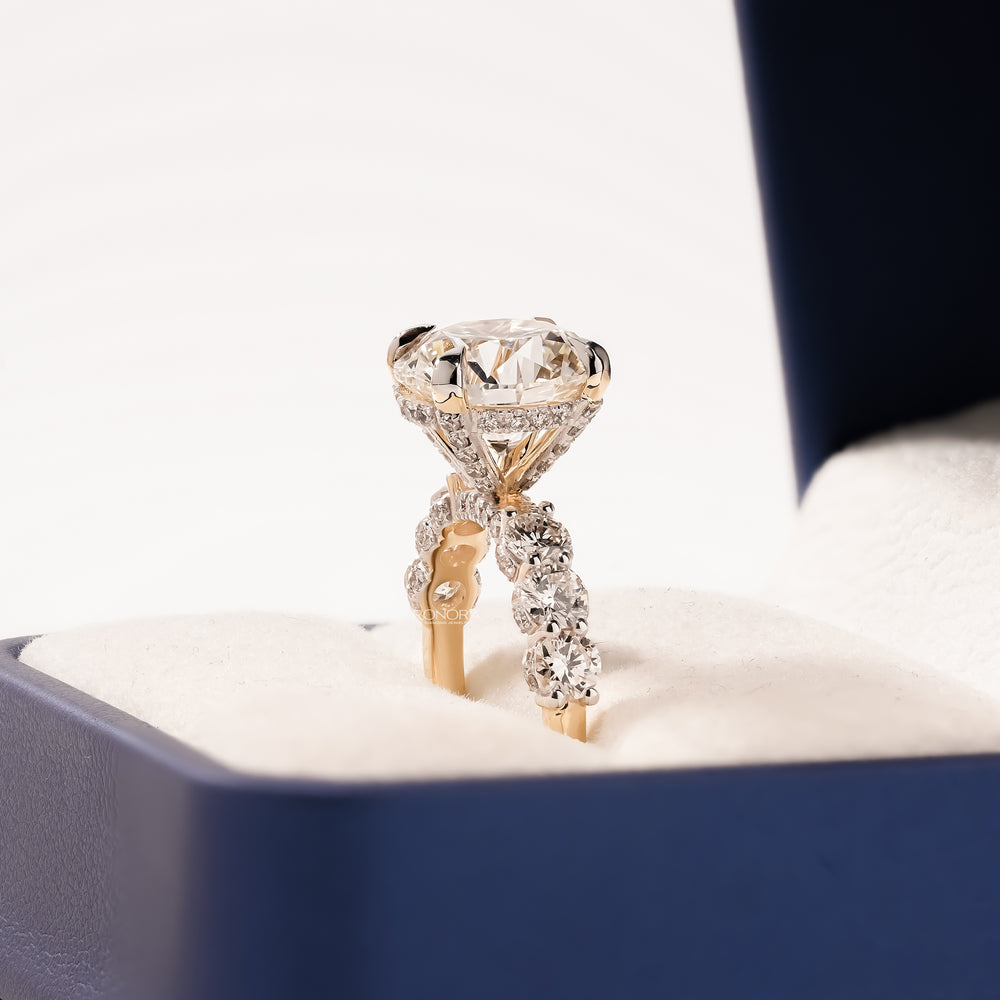
A wide pavé band, the kind of detail that suits a cushion's vintage character
Cushion Cut vs Other Diamond Shapes
Cushion vs Round. The round is brighter and spreads more per carat. The cushion is softer, warmer and noticeably less common. Choose round for maximum sparkle, cushion for character.
Cushion vs Princess. Both are squares. The princess is sharp, modern and has corners that chip. The cushion is rounded, antique and effectively indestructible.
Cushion vs Radiant. Both soften a square, but differently. The radiant crops its corners and sparkles sharply; the cushion curves them and glows.
Cushion vs Elongated Cushion. Same faceting, stretched. The elongated version flatters the finger the way an oval does while keeping the soft pillow edges.
Pros and Cons of the Cushion Cut
What it does well
Rounded corners make it extremely durable; nothing can chip.
Genuine antique character that no modern cut reproduces.
Hides inclusions well, especially in crushed ice form.
Lower price per carat than a round.
Suits vintage, milgrain and halo settings better than any other shape.
What to watch
Chunky and crushed ice are very different stones sold under one name.
Spreads less per carat than most shapes, so it can look smaller than its weight.
Holds colour a little more than a round.
No official cut grade, so proportions must be judged individually.
Explore Ronora’s Cushion Cut Collection
Every Ronora cushion is a real lab grown diamond (CVD), Excellent cut, in the D-E-F colourless range, set by hand in Surat in solid 9K, 14K or 18K gold, platinum or 925 silver. Tell us whether you want chunky or crushed ice and we will match the stone to it. Our cushion range is still growing, so if you have a specific ratio or facet style in mind, ask and we will source it. Browse our lab grown diamond engagement rings, or compare the cushion against the other eleven shapes in our diamond shapes guide.
Join for new designs, ring guides and private offers.
Sign up in one step with Google or your email.
By signing up, you agree to receive Ronora Diamond marketing emails and accept our Privacy Policy. You can unsubscribe at any time. The 10% code works once, on your first order.