


Cart
0


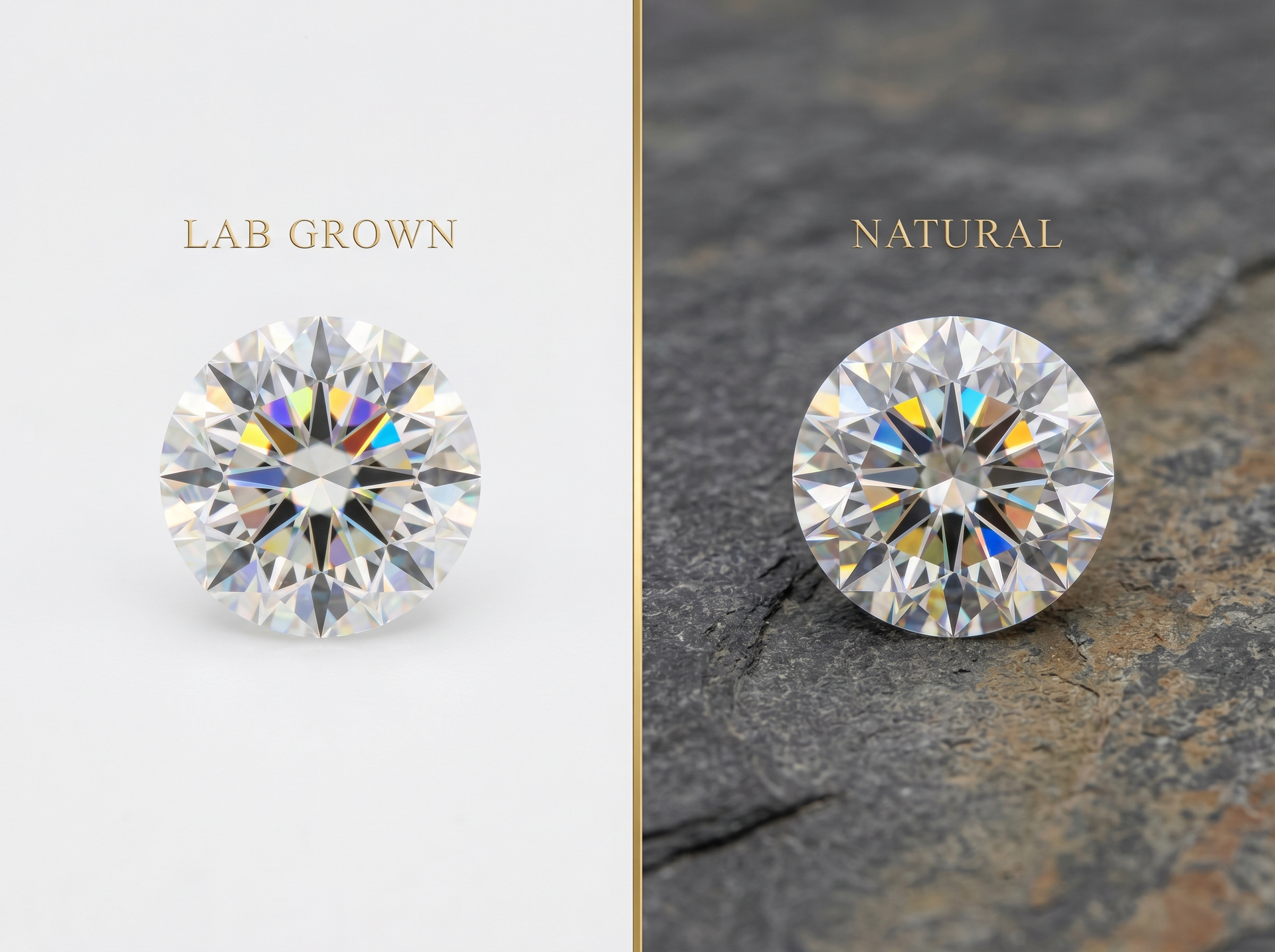
In 2026, more than 60 percent of engagement rings sold in the United States feature a lab-grown diamond. Five years ago, that number was under 10 percent. Something changed -- not in how diamonds sparkle, but in how buyers think about value, ethics, and what a diamond actually is.
If you are considering a lab-grown diamond but still have questions about how it compares to a mined stone, this guide covers everything honestly.

What Is a Lab Grown Diamond?
A lab-grown diamond is a real diamond. Not a simulant. Not a substitute. It has the same carbon crystal structure, the same hardness (10 on the Mohs scale), the same refractive index, and the same fire and brilliance as a mined diamond. The only difference is where it was created.
At Ronora, every diamond is grown using CVD technology -- Chemical Vapor Deposition. A small diamond seed is placed in a controlled chamber and exposed to a carbon-rich gas. Over several weeks, carbon atoms bond layer by layer, growing a crystal that is chemically and physically identical to a diamond formed underground over billions of years.
Are Lab Grown Diamonds as Good as Real Diamonds?
Yes -- they are real diamonds. The GIA (Gemological Institute of America) grades lab-grown diamonds using the same 4C scale as mined diamonds: cut, color, clarity, and carat. IGI, the world's leading lab for grading lab-grown diamonds, issues the same style of certificate for a lab-grown stone as for a mined one.
A jeweler examining a lab-grown diamond cannot distinguish it from a mined stone by appearance alone. Advanced laboratory equipment is required to tell them apart. The only visible mark of origin is a microscopic laser inscription on the girdle identifying it as laboratory-grown.

The Price Difference
This is where lab-grown diamonds fundamentally change the conversation. A 1-carat CVD diamond in VVS clarity and D-E-F colorless grading currently costs 60 to 80 percent less than an equivalent mined diamond. At Ronora, this means you can choose a larger center stone, a more intricate setting, or a higher-karat gold for the same budget.
That is not a marginal difference. A 2-carat oval lab-grown diamond in VVS clarity can cost less than a 0.8-carat mined diamond of comparable quality. The value per carat is dramatically better.

What Are the Disadvantages of a Lab Grown Diamond?
The honest answer: resale value is lower. Mined diamonds hold a modest secondary market value. Lab-grown diamonds currently resell at a much lower price. If you are buying a diamond as a financial asset, this matters.
For most buyers, a diamond ring is not purchased to resell. It is purchased to wear, to mark a moment, to last a lifetime. On those terms, a lab-grown diamond performs identically to a mined one -- and over years of daily wear, nobody will look at your ring and see anything other than a diamond.
Do Rich People Buy Lab Grown Diamonds?
Increasingly, yes. Lab-grown diamonds are not positioned as budget alternatives -- they are chosen by buyers who want the largest, highest-quality stone and understand that CVD technology produces diamonds of equal quality to mined stones. At the high end, 3-carat and 5-carat CVD diamonds in VVS clarity are purchased by buyers who simply want the best stone, without paying a premium for origin.
The Ethical Dimension
Mined diamonds require significant land disruption, water use, and complex supply chains. Lab-grown diamonds produced via CVD have a smaller environmental footprint and a fully traceable origin. No mining communities displaced. No conflict sourcing concerns. No opaque supply chains.
At Ronora, every diamond is CVD lab-grown. VVS clarity. D-E-F colorless. Conflict-free by design. Browse engagement rings or explore the full lab-grown diamond collection.

Frequently Asked Questions
Are lab grown diamonds as good as real diamonds?
Yes. Lab-grown diamonds are real diamonds -- chemically, physically, and optically identical to mined stones. They are graded by the same international standards and perform identically in everyday wear.
What are the disadvantages of a lab grown diamond?
The main disadvantage is lower resale value compared to mined diamonds. For buyers who wear their ring rather than resell it, this has no practical impact on quality or appearance.
Can a jeweler tell a lab grown diamond from a mined diamond?
Not with the naked eye or a standard loupe. Laboratory equipment is required to distinguish them. All CVD diamonds carry a microscopic laser inscription on the girdle confirming their lab-grown origin.
How much cheaper are lab grown diamonds than natural diamonds?
Lab-grown diamonds typically cost 60 to 80 percent less than equivalent mined diamonds of the same cut, color, clarity, and carat weight. This allows buyers to choose larger or higher-quality stones at the same price point.


